I have to say, I'm pretty surprised that I am writing a paper about children's reading (and still trying to figure out exactly what that will mean), but I think it is potentially a very fun topic.
I decided I'll go ahead and document my writing process on the blog, so the following are all the ideas - good or bad - that come to mind.
Showing posts with label Printing Knowledge. Show all posts
Showing posts with label Printing Knowledge. Show all posts
Friday, December 2, 2011

Thursday, December 1, 2011
Movable Type Printing from... Asia?!

There is a common misconception that in 1450 Johannes Gutenberg created the first movable type with his invention of the printing press. The reason this statement is false is that like with many other western inventions, the Chinese figured it out way before we thought of it! The Chinese began using the movable type system for printing around 1040 AD. A man by the name of Bi Sheng created this system during the Song Dynasty. This movable type system replaced what was called woodblock printing.

With woodblock printing, one printing plate could be used for thousands of books, this played a signifcant role in spreading culture in China. But carving the plate was very time consuming and required much labour. Larger books required many years of work and effort. The plates needed a lot of room for storage space, and were often damaged by deformation, worms, and corrosion. If books had a small print run, and were not reprinted, the printing plates would become nothing but waste and if a mistake was found, no matter how minor, it was difficult to correct it without discarding the whole plate. These difficulties led to the popularity of the new invention of the movable type printing process.

The first form of movable type was created using ceramic materials.This system created by Bi Sheng was much more efficient than woodblock printing. The process was described by the Chinese scholar Shen Kuo:
"When he wished to print, he took an iron frame and set it on the iron plate. In this he placed the types, set close together. When the frame was full, the whole made one solid block of type. He then placed it near the fire to warm it. When the paste [at the back] was slightly melted, he took a smooth board and pressed it over the surface, so that the block of type became as even as a whetstone.
For each character there were several types, and for certain common characters there were twenty or more types each, in order to be prepared for the repetition of characters on the same page. When the characters were not in use he had them arranged with paper labels, one label for each rhyme-group, and kept them in wooden cases.
If one were to print only two or three copies, this method would be neither simple nor easy. But for printing hundreds or thousands of copies, it was marvelously quick. As a rule he kept two forms going. While the impression was being made from the one form, the type was being put in place on the other. When the printing of the one form was finished, the other was then ready. In this way the two forms alternated and the printing was done with great rapidity"

The ceramic movable type was then replaced by wood and eventually metal. Although the first metal movable type was created in 1234 during the Goryeo Dynasty of Korea and is credited to Choe Yun-ui, the credit goes to Gutenberg for the invention of the metal movable type printing press. He was able to master the printing press using metals such as alloy of lead, tin and antimony for his plates which were much more efficient than the iron used in Asia. Those same components are actually still used today in the printing press! So now you know that many Asian inventors experimented with different forms of movable type printing systems, but the reason we only hear about Gutenberg is that his mastery of the movable types had the greatest impact on the way we learn and transmit knowledge.
Monday, November 28, 2011
The Force of Printing
 | |||||||
| Just thought this was amazing! |
Saturday, November 19, 2011
Annotated Bibliography: The Printed Book and Its Effects
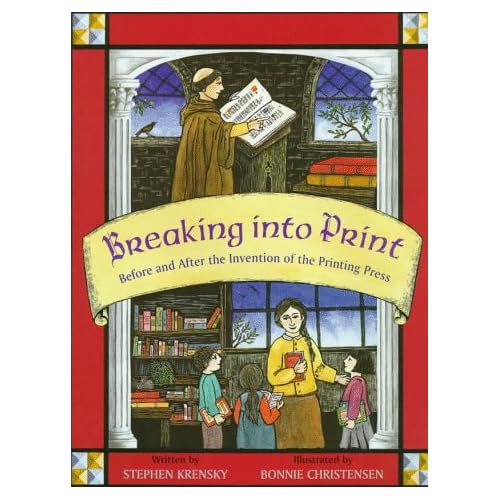
My bibliography presents some books about the history of printing and its impact on the world.
Bibliography Scavenger Hunt! Plagiarism

I began my hunt early Saturday morning. I had walked through this magical forest before, looking for books, and knew the hard task which I faced. Finding a few books in the thousands that were out there would be very difficult. First, I needed to decide which species I was looking for. I decided that I would research plagiarism, since I have a research paper due today and that is one of the things that one tries to avoid wholeheartedly. Once I had determined this, I needed to know where to locate my prey. I pulled out my secret weapon...my laptop. I pulled up the Harold B. Lee Library's website, typed in the word "Early Plagiarism", and, quick as a gazelle, I had found a book and a periodical. Once I had captured my first target-the book-the rest was relatively easy. That book led me to it's friends, other books that also had to do with the same subject.
Subscribe to:
Posts (Atom)