Showing posts with label Folk knowledge. Show all posts
Showing posts with label Folk knowledge. Show all posts
Saturday, November 19, 2011

Friday, September 23, 2011
Segway to Oral Knowledge
 As we began our unit on oral knowledge in class today, I couldn't help but think about how language itself is really a form of folk knowledge. And it's one of those things that we learn without even realizing that we're learning, tying it in perfectly with the discussion in Sam's post from Tuesday about how we just seem to automatically absorb some knowledge.
Friday, September 16, 2011
Trees with Ease
 |
| Me teaching the other Jenna the tree pose |
Camping

I've never been, and I am so excited. What I'm also excited for is the chance to do some camping.
When I was growing up, my family had a tradition of camping for Thanksgiving. I have so many good memories of helping set up camp, watching my dad build big fires, and taking hikes in the woods. It's been a couple years now since I've been camping, so I am stoked for this weekend!
Hence...I can't help but want to write about the folk knowledge of camping for my blog post this week. Please humor me.
One of the first things I wondered about camping was how in the world I could address it in terms of our history learning outcome. In its current form, it's actually a relatively new thing. The "invention" of camping as a recreational activity is credited to Thomas Hiram Holding who wrote a handbook about it in 1908. Yes, the knowledge was recorded and thus came out from the realm of pure folk knowledge, but bear with me because Holding's own history is a great example of the transmission and transformation of folk knowledge.
Holding developed his passion for camping as a 9-year-old when he crossed America's plains with his parents as part of a wagon train. You can read more about his life and contribution to camping here, but what I love most about his story is that he found pleasure in the skills that he learned as part of everyday life - how to cook, sleep and perform other essential tasks outdoors - to that point that practicing those skills became a form of recreation for him later in life.
I don't think anyone can deny that camping is a lot of work. Today, we don't learn the skills that it requires as part of our everyday life, but instead enjoy them as a specialized type of folk knowledge that allows us to challenge ourselves and enjoy nature. I know that's what I'll be doing this weekend! And who knows what new camping skills I might pick up along the way?
Wednesday, September 14, 2011
Sticking With It

I will apologize in advance everyone for not having a good picture to accompany my post. You will see why in a moment! I decided to have my friend Christ teach me how to drive a manual car. The so called "stick shift" approach to driving, as I have heard from some, is supposed to be much more exciting than the automatic approach. I did NOT find that to be the case.
This skill requires a lot of coordination and good timing. I quickly learned that I take for granted what my automatic car, named Scarlet, does for me. So, as you begin driving, you have to press down the clutch and the brake pedal in order to start the car. I became good at this very quickly because of all the times I had to start the car up again. As you begin to accelerate, you must slowly release the clutch pedal. If you don't do it with quite the right touch, the car will stall and the embarrassment sets in. Overall, I stalled a grand total of 5 times in about 25 minutes.
Have you heard the saying "go big or go home"? I really tried hard to implement that into this assignment. Don't worry, I wasn't speeding around campus or throwing water balloons at couples passing by. I simply decided to get the police involved! The first time I stalled I saw some red an blue flashing lights pull up beside us. How much more embarrassed could I be! We were in a parking lot for heaven's sake. Apparently, my buddy's car had expired plates. I was very, very tempted to ask fora picture with the officer, but he seemed to be having one of those nights, so I controlled myself. In terms of stepping outside my comfort zone, I think stalling right in front of an officer who was pulling me over has to count for something.
Folk knowledge is a lot more dangerous than I thought! I didn't know that the police would show up when I tried to deepen my appreciation for folk knowledge. Although we grow up and naturally learn some types of folk knowledge, many of them must be practiced, and practiced, and practiced some more. The best way to claim knowledge as your own seems to be to practice it and then to teach it.
Sunday, September 11, 2011
The Ancient Art of Yoga
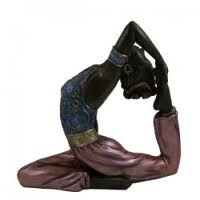
A well-respected yoga instructor, B.K.S. Iyengar, once said of the exercise, "Yoga teaches us to cure what needs not be endured and endure what can not be cured."
Though yoga has been around for at least 5,000 years, its popularity has grown immensely in the past decade as its health benefits have been advocated. The word yoga means "to join or yoke together" and its purpose is to unify the mind and body, which helps one better accomplish what Iyengar taught. Yoga today is based on:
- Breathing
- Exercise
- Meditation
Friday, September 9, 2011
Business Etiquette 101
 Have you ever thought about living in a foreign country? Of course! Who doesn't want to go float around in Venice or cruise around in the Caribbean? Now, once you are there, have you considered getting a job or doing business while you are there? Have you ever considered how doing business with Caesar might be different than doing business with Mandela? Let's take a look.
 Business transcends time and cultures, but the way it is practiced depends on where and when. No matter where or when, as a business person you MUST be aware of your hosts business customs. For example, my grandma is from South Africa, so let's take a look at what has become the "do's" and "do not's" of South African business. First and foremost, how should you look? You will expected to dress well in public. In South Africa, you don't typically present gifts as a part of your exchanges. However, if you decide to make that gesture, DO NOT present gifts with your left hand! P.S. - If you are in a hurry you better be careful. South Africans take a casual approach to business and they are in no rush.
Now, let's say you are on the road to Damascus and you realize that you have forgotten your pen and paper to make and sign a contract with a fellow businessman. Is that going to be a problem? Lucky for you, everything will be okay. In many ancient civilizations, individuals had personal seals that they would stamp into clay in order to finalize a contract. The art of creating these seals is a form of folk knowledge in and of itself. They are beautiful seals, some like stamps and others that you would roll into a clay tablet to be used as your signature. http://www.bible-history.com/sketches/ancient/seals.html I wasn't able to find anything on this, but something that really interested me is if these seals and stamps were passed down the family line or if each individual created their own. I will do a little more research on that to see which was the common practice.
As cultures and civilizations show us, business customs are unique to each place in each time. Do we go to school to learn about these customs? Nope. We just grow up seeing and observing these practices and it becomes a part of who we are. But, if we ever hope to be successful in an international business venture, we had better educate ourselves about how they do it "over there".
Monday, September 5, 2011
The Magic of Music
While I was thinking of a good topic to post about, I remembered a quote from a book that I had been reading a couple of weeks ago, (one of the best books ever, in my opinion) Harry Potter. The students had just finished singing the Hogwarts song, and Dumbledore stood, wiped a tear from his eye, and said, "Ah, music, a magic far beyond all we do here." And music is just that. It has great power and can be used to uplift, to celebrate, to tell stories, to release oneself from the cares and hardships of the day. It both defines and unifies cultures. It can be used to tell a history, how something once was, and can be passed from generation to generation.
I was involved in music through high school and learned to love both instrumental and choral music. However, with choral music, I saw something at the corner of many of the sheets of music that I did not usually see in band-the words traditional or folk song. These were songs that had been passed down for so long, usually to tell a story, that no one knew who wrote them.
My favorite type of music that we performed were the both the African and the African-American songs. They just had this great beat and soul to them. These songs were passed down from generation to generation, and the people were able to sing to remember their country and heritage as well as to plead for freedom. In his autobiography, Frederick Douglass said, "They would make the dense old woods, for miles around, reverberate with their wild songs, revealing at once the highest joy and the deepest sadness. They would compose and sing as they went along, consulting neither time nor tune. The thought came up, came out-if not in the word in the sound-and as frequently in the one as the other."
(see http://sunsite.berkeley.edu/Literature/Douglass/Autobiography/02.html)
Being able to weave one's soul into music is what makes it magical, where it can touch the hearts of many generations and live on for ages.
I was involved in music through high school and learned to love both instrumental and choral music. However, with choral music, I saw something at the corner of many of the sheets of music that I did not usually see in band-the words traditional or folk song. These were songs that had been passed down for so long, usually to tell a story, that no one knew who wrote them.
My favorite type of music that we performed were the both the African and the African-American songs. They just had this great beat and soul to them. These songs were passed down from generation to generation, and the people were able to sing to remember their country and heritage as well as to plead for freedom. In his autobiography, Frederick Douglass said, "They would make the dense old woods, for miles around, reverberate with their wild songs, revealing at once the highest joy and the deepest sadness. They would compose and sing as they went along, consulting neither time nor tune. The thought came up, came out-if not in the word in the sound-and as frequently in the one as the other."
(see http://sunsite.berkeley.edu/Literature/Douglass/Autobiography/02.html)
Being able to weave one's soul into music is what makes it magical, where it can touch the hearts of many generations and live on for ages.
Subscribe to:
Posts (Atom)